Dr Sally Dowen on curiosity, conviction, and becoming the leader she once needed
Early Curiosity: A Childhood Spark in Science
International Women’s Day often celebrates breakthroughs, firsts, ceilings shattered and milestones claimed. But most careers unfold less dramatically. They build slowly through encouragement, opportunity and moments when stepping forward becomes necessary.
Dr Sally Dowen’s story begins not with ambition, but with fascination.
As a child in primary school, she remembers hatching chicks and watching development take place inside something fragile. “It just sort of really spoke to me,” she says. There was no grand epiphany, just curiosity. Life had structure, and biology made sense.
Later came what she calls a “light bulb moment” during a lesson on human physiology, particularly the heart. She remembers thinking, “Wow, this is incredible, like working out how our bodies work.”
It never occurred to her that science might not be an option. For many girls, possibility narrows quietly over time, but for Sally, it did not thanks to a teacher who believed in her and made sure she believed in herself.
The Power of Mentorship in Shaping a Woman’s Career
There was a biology teacher who saw further than she did. Applying to Oxbridge had not crossed Sally’s mind, but her teacher put her forward, mentored her through the process, practiced interviews, and, as Sally puts it, “She really drove me to achieve my potential.”
When she speaks about this woman, the gratitude remains immediate.
“I think having that person, that woman who invested in me, that wasn’t a family member, that was really amazing.”
Sadly, her teacher died of breast cancer during Sally’s final year of high school. She never saw the PhD, nor the leadership roles that followed. But the confidence she nurtured continues to shape her, even now.
Pursuing a PhD in Cancer Research
At university, Sally gravitated towards cancer research and after a lecture series on HPV and cervical cancer, she approached the lecturer directly and said, “I really would like to do a PhD and I find your research really inspirational.”
The reply was simple: “Well, I’m looking for a PhD student.”
From that simple interaction, she went on to complete her doctorate in cervical cancer and a postdoctoral role in pancreatic cancer. But academia revealed its harsher edges.
“The life in academia is quite tough. You’re on a constant cycle of trying to find funding.”
Eventually, she made what she describes as “the hard decision that it really wasn’t for me.” She loved science. She loved writing. She loved using her scientific knowledge. But she wanted to see research applied more directly, without being defined by grant cycles.
Transitioning into Clinical Research Leadership at Hammersmith
An advert for a clinical project manager at Hammersmith Medicines Research provided that shift. Even then, she was told it would be difficult to enter clinical research at that level, yet she applied anyway and, as she says, “And lo and behold, I got the position.”
What followed was seventeen years at HMR where she began as a clinical project manager and progressed to Director of Clinical Science and Regulatory Affairs, which saw her overseeing projects, medical writing, regulatory affairs and clinical project management.
During those years, life also accelerated outside the office.
“I had three boys within eighteen months, twins and then another one.”
The sentence sounds almost casual, but the reality was anything but. Three small children alongside a growing leadership role and the constant “life admin and organisation around the children.”
However, what she emphasises is not struggle, but support.
“I was really fortunate that Hammersmith supported me while I was having my family.”
They adjusted her hours and her role, allowing her to maintain continuity in her career at a time when many women lose it.
“I don’t take that for granted ever.”
In conversations about women in leadership, resilience is often celebrated, but Sally’s story suggests something equally important.
Structure matters and institutional support matters.
A Defining “Sink or Swim” Leadership Moment
Five years into her time at Hammersmith, leadership arrived abruptly when her manager, who was pregnant at the time, had to take leave immediately. Leaving Sally and another colleague to run the department in what she describes as “It was kind of do or die. There were no backup plans, it was sink or swim.”
There was a quiet realisation that “There’s nobody else here to do the job, so I need to step up and get this done.”
It was not a formal promotion, but a necessity, and that necessity clarified something lasting.
“How your team performs is a direct reflection of whether you’re a successful leader or not,” she says now. For her, leadership is not about hierarchy, but about ensuring people are supported, heard and empowered.
Leading Through Regulatory Turmoil at the MHRA
After seventeen years, she sought a new challenge and joined the U.K. regulator, the MHRA, as Head of Clinical Trials.
She entered during what she describes as “real turmoil.” The pandemic had disrupted systems, Brexit had reshaped regulatory structures, and a significant backlog of clinical trial authorisations meant legislative timelines were being missed.
She was tasked with clearing the backlog and creating sustainable new ways of working. The work was urgent, high pressure and highly visible.
“Honestly, I was quite burnt out by the end of that,” she says.
She delivers it without emphasis. Burnout, in her framing, feels less like failure and more like the predictable result of carrying too much for too long.
Returning to Lead: A Full Circle Career Moment
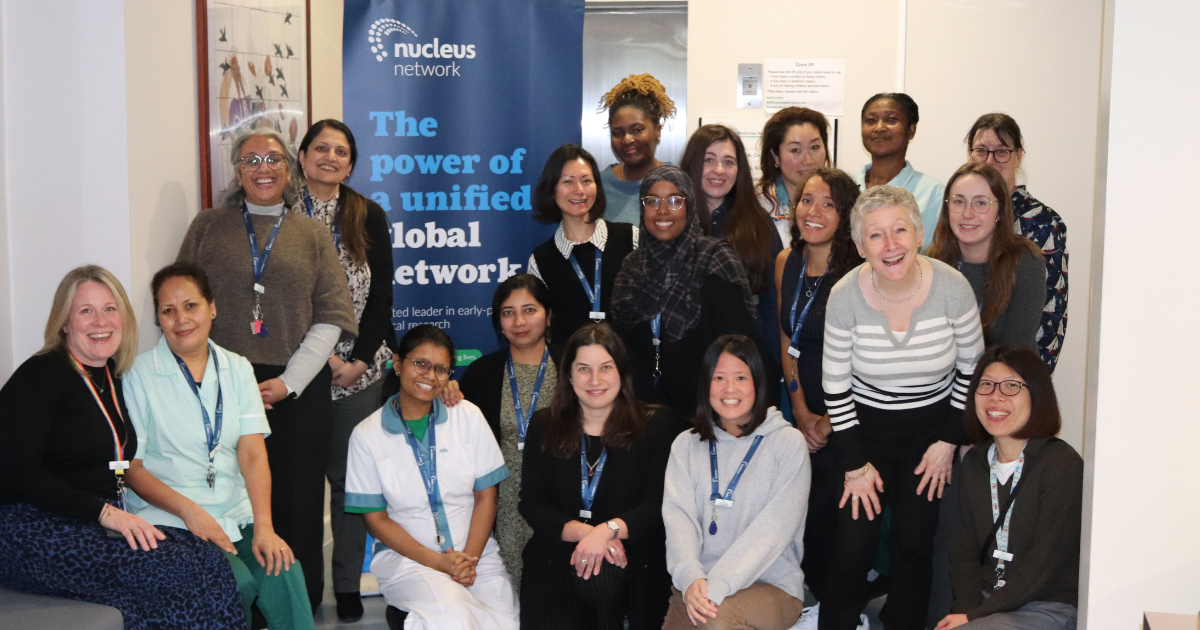
After consulting across biotech, academia and CROs, her career took on an almost circular symmetry. Nucleus Network moved to acquire Hammersmith Medicines Research in mid-2025 and she was approached by CEO Teena Pisarev to lead the site she had once joined as a project manager.
“That’s how I came to my new role.”
Today, she leads the London site with a focus on optimisation, integration and culture, while ensuring that legacy ways of working and new approaches coexist productively.
Advancing Medicine and Improving Patients’ Lives
Her motivation still remains anchored in impact.
“It’s research and health overall that motivates me and improving things for patients.”
She speaks of people with no effective treatments and of the urgency that underpins early phase research. Her father-in-law’s Alzheimer’s diagnosis makes that urgency deeply personal.
“Seeing that trajectory is really hard.”
Alongside her executive role, she serves voluntarily on a U.K. ethics committee reviewing Phase I research, paediatric studies and gene therapy products.
“That’s my bit of good to try and progress things even more rapidly for patients.”
Yet she resists reducing her motivation to altruism alone.
“Actually selfishly, I just really like understanding the nuts and bolts,” she says. “It’s the science. It’s the understanding how things work. It’s not all altruism.”
This reveals something essential about her character. Compassion and curiosity are not opposing forces. They coexist. The desire to ease suffering sits comfortably alongside the instinct to understand mechanisms, systems and structure. For her, advancing medicine is both deeply human and intellectually compelling.
Her Message on International Women’s Day
When asked what she would say to women entering science, her message is direct.
“Believe in yourself.”
The advice sounds simple, but it carries the weight of lived experience, through the teacher who pushed her to apply, the moment she walked up and asked for a PhD, the decision to step forward when no one else would.
As she puts it, “The sky’s the limit, provided you have the courage to strive for your goals. You can achieve anything you want to.”
But belief, in her view, is not something cultivated alone.
“Support each other,” she says. “You need your girlfriends to back you too.”
There is something deeply practical in that framing. It is not abstract empowerment or polished slogans, but the creation of a net, a circle of people who reinforce your confidence when it wavers.
“Form your net and find your people.”
Her own career was scaffolded by exactly that: a teacher who invested in her, female role models she “definitely doesn’t take for granted,” and colleagues who stepped forward alongside her when it was “sink or swim.”
International Women’s Day often centres on individual achievement, but Sally’s message gently reframes it. Progress, she suggests, is rarely solo and it is built collectively.
Celebrating the Women Around Us
Dr Sally Dowen is just one of the many remarkable women across our organisation whose stories are defined not only by achievement, but by conviction, curiosity and quiet leadership. On International Women’s Day, we celebrate her journey and recognise the extraordinary women across our global teams who continue to advance medicine, mentor others and step forward when it matters.
Progress is never the story of one woman alone. It is built collectively through expertise, resilience, support and belief. When women back themselves and each other, the impact extends far beyond any single career.